Comments Welcome

To add a comment to any post on this blog, select the post by clicking on the title either in the post itself or in the list of posts on the left of the page. Then scroll down to the foot of the post and type your comment in the box.

Tuesday, 23 February 2016

Problems With Perth Freight Link: Practical and Philosophical

Last Wednesday, 17th February, I spoke as an invited speaker on behalf of the STCWA at a public meeting organised by the Hilton Action Community to discuss issues with the Perth Freight Link. Whilst this meeting was most directly prompted by Transport Minister, Dean Nalder's promoting a tunnel option for a large part of the PFL, it was concerned about all elements - from roe 8, with its major environmental issues, to the lack of connection to the Port itself.

My speaking notes follow, below.

Planning and Governance

Reservations for major roads in Perth are defined in the Metropolitan Region Scheme (MRS), usually for many years, prior to the road being built.
While some parts of the current PFL are shown in the MRS, others are not. To get them into the MRS requires a statutory process by the WA Planning Commission, including public submissions, and formal adoption.
It may not be legal to build those parts of the PFL that are outside an MRS highway reservation. This would appear to include parts of High St, and land for new grade separations at Stock/Leach, Carrington/Leach, High/Stirling and Stirling/Marmion and large parts of any tunnel option.
We should be looking very closely at the Main Roads Amendment Bill currently before Parliament. This grants powers to the Commissioner of Main Roads to undertake works outside road reservations, including clearing vegetation without the need to comply with the Environmental Protection Act.
Infrastructure Australia says the Business Case lies (or at best misleads) about alignment with State Strategic Priorities:
"The Business Case outlines strong links between the Perth Freight Link Project and State priorities, policies and initiatives … but the Perth Freight Link project is not directly mentioned in any of the State plans and policies it mentions.
This appears to be yet another reason why the 'Moving People' and 'Moving Freight' strategies are being rewritten - to comply with the Government’s political narrative.

Contractual

The current PFL proposal appears to be to call tenders for its construction soon: before details have been decided and before the statutory planning process has been completed.
This will create significant risk and uncertainty for potential tenderers to build the PFL, especially when combined with uncertainty about with the proposed sale of the Fremantle Port and the possibility of a change of government.
Letting a contract for the PFL under these circumstances will mean it will cost tax-payers more than if the details have been decided through proper process.
Tenderers will either load their prices up-front to allow for the uncertainties or prepare their tenders in such a way as to maximise extra payments during the course of the contract.
Either way it is certain to be expensive.
It also increases the probability of litigation between the State and the successful tenderer if the uncertainties continue to grow. This will tend to result in delays and further costs that will only be productive to the legal profession.
Exactly the same applies to the sale or leasing of Fremantle Port, which the Minister for Transport has said he wants to have signed off by July/August.
Tenderers will reduce the price they are willing to offer if PFL is uncertain.
If the Port is sold with an expectation about the PFL that is not finally met, the State will be exposed to litigation.
It would save significant taxpayers money and possible litigation to first finalise planning for port development and freight access and then, if you must, offer the Port for sale.


Appraisal

Public investment is usually assessed using benefit-cost analysis. A project is only justifiable if:
a)   the benefits over time exceed the costs; and
b)   the amount by which they do so is greater than for any alternative way of addressing the problem.
The second, in particular, has not been demonstrated for the Perth Freight Link.

Infrastructure Australia itself has not been able to get sufficient information to satisfy itself that the PFL is the best option for dealing with the land transport needs of WA's international container trade.

Indeed, IA 'damns with faint praise' when it concludes:
 "After accounting for these [risk and uncertainty] factors, Infrastructure Australia still has a high degree of confidence that the BCR is greater than 1.0:1 for the project".

According to IA, "Major risks for the project include costs, environmental approvals and community support", which doesn't leave much in the way of certainty, especially as the final link to the port has not yet been defined or costed.

IA could not state that the project is warranted because it didn’t have comparable information on alternatives and therefore could not assess whether other options would provide better value to the WA community.

The evaluated PFL project was selected from 12 possible ones on the basis of subjective criteria, with only the 'preferred' project being subject to full benefit-cost analysis.

None of the 12 options included adequate consideration of the Outer Harbour.


Ethics

Engineers Australia’s Code of Ethics requires professional engineers to promote sustainability. This includes engage responsibly with the community and other stakeholders:
- being sensitive to public concerns
- informing employers and clients of the likely consequences of proposed activities on the community and the environment
- promoting the involvement of all stakeholders and the community in decisions and processes that may impact upon them and the environment.
It also includes:
- balancing the needs of the present with the needs of future generations
- considering all options in terms of their economic, environmental and social consequences
It is clear that the present PFL process is not promoting the involvement of all stakeholders and the community in decisions and processes that may impact upon them and the environment.
It is clear that not all options have been considered in terms of their economic, environmental and social consequences; especially the development and use of the outer harbour and the option of moving freight at night.

It is unfair of the Government to put professional engineers involved in the PFL in a position where they are being asked to act unethically.

Written and Posted by Ian Ker, Convenor, STCWA

Is Dean Nalder A Mole?

Is Dean Nalder a mole in the WA Government?

He is obsessed with burrowing underground and, in the process, undermines his own government, as a spy might do, by floating whacky ideas.

It is true that destroying existing urban development to widen roads like Stirling Highway is of questionable value, but transport professionals know that building more roads, however you do it, is no solution to congestion - quite the opposite, as more roads simply generate more traffic. 

And if you did build, say, another Stirling Highway under the existing one, where and how would drivers get on and off - or must they all go all the way from Perth to Fremantle? Access/egress points would take large amounts of land - most likely at places where land is at a premium, because those are the places people want to get to.

Cheap though tunnelling might be in Perth sand, the cost would still be substantial. It is disingenuous of the Minister to claim that it would not be at the expense of public transport and cycling - unless he has somehow found the money tree that Premier Colin Barnett appears to believe exists somewhere, if only he could find it.

It's time, Minister, to commit to cost-effective strategies for walking, cycling and public transport to provide real options for the people of Perth, which would also improve road traffic conditions for those who still have to use cars, commercial and freight vehicles.

The West Australian, 23rd February, 2016

Thursday, 10 December 2015

Energy Security, Infrastructure and Risk-Management

Recent media reports (eg "Collateral Damage Takes Toll" by Ambrose Evans-Pritchard, at foot of this post) have renewed discussion of energy futures and energy security, especially for transport. On Tuesday 8th December, the STC wrote the letter below (not yet published) to the West Australian:

Dear Sir,

We note with alarm the themes documented in the business columns of last Saturday's West Australian ("Collateral Damage Takes Toll" by Ambrose Evans-Pritchard).  In light of the risks to global oil security and the near certainty of renewed oil price inflation in the near future we cannot understand the absence of strategic risk management and appropriate infrastructure investment in Australia.

Australia fails to abide by the oil storage commitments required by the International Energy Agency.  Adding insult to injury, oil refineries in the nation are being closed down as though they are fast going out of fashion, such that 90% of our refined fuels are being imported!!  Meanwhile our State Government has only managed to extend our rail network by a few kilometres since coming into power (the extension of the Butler line in 2014).  It has "postponed" MAX light rail and purchase of new rail cars, and is closing freight rail lines in the Wheatbelt, our very own Bread Basket.

Other state capitals are busily constructing new passenger rail lines and 21st Century  light rail systems.  Overseas countries are also 'doubling down' on public transport investment, while some countries such as Norway are also promoting the use of electric vehicles by their population.    

We hope the time is not too distant when our governments undertake proper risk management and re-evaluate their infrastructure investment and energy security priorities.  This will help protect our country and our State from future energy supply shocks and the disastrous impacts of runaway oil price inflation. 

The same day, the ABC reported Senator Bill Heffernan's expressing similar concerns on fuel security - not only in its own right but also for its potential effect on national security as a whole.
http://www.abc.net.au/news/2015-12-08/fuel/7012166

As we noted in our letter, it's time to undertake proper risk management and re-evaluate infrastructure investment and energy security priorities.
http://www.pressreader.com/australia/the-west-australian/20151205/282278139261298/TextView
Posted by Ian Ker, Convenor, STCWA

Wednesday, 11 November 2015

Multi-Storey Car Mausoleums Are Our 'Horse Graveyards'

Good piece in today's West Australian by Kate Emery, who does us all a great service by drawing attention to the myopia of planning ('They shoot horses, don't they', West Australian, 11th November 2015), using the example of the 'horse graveyards' planned as an 'inevitable' result of dependence on horse-drawn transport in the 19th century.

Our horse graveyards are already with us, in the form of multi-storey car parks. These single-purpose mausoleums are home to inanimate car bodies for most of the day and empty by night.

There is nothing new in planners wanting to reduce our dependence on the private car by creating more accessible places. Twenty years ago, the Perth Metropolitan Transport Strategy stated on its front cover:
"Perth will be a place of vitality and well-being. There will be a sharing of spaces for living, work and leisure activities, which can be reached easily and safely by all members of the community".

If we were actually to achieve this, many of these car mausoleums would be redundant. Indeed, we can already see the beginnings of this in reduced charges (because of lower demand) for car parking in the central city.

Now we need to take the next step and start to reduce the amount of car parking, including requirements in local government town planning schemes - which also increases the density and activity we can get in an area. To do so requires governments to get serious about creating more accessible places, not simply set arbitrary infill development targets, and to make alternatives to the car (public transport, walking and cycling) feasible options for as many of us, in as many places and for as much of the day as possible.
West Australian, 11th November, 2015
Written and Posted by Ian Ker, Convenor, STCWA

Sunday, 1 November 2015

Perth Freight Link: Suspended or Dead in the Water

Premier Colin Barnett has a habit of white-anting his Ministers and hanging them out to dry (apologies for the mixed metaphors). Witness the appalling treatment of Local Government Minister, Tony Simpson, during the local government so-called reform process of 2014-15, when Simpson was still talking it up while the Premier was ready to run up the white flag.

In the case of the Perth Freight Link, this is far from the first time that he has left Transport Minister, Dean Nalder, red-faced and defending the indefensible. It raises the question, though, of how someone as closely-identified with the project as the Premier can say, now, that the PFL is "incredibly complicated, incredibly expensive for what it does" - when it was obvious to so many right from the start that this was so.

Add to that, the very real concern that "what it does" is not what is in the best interests of Western Australia - as evidenced by decades of bipartisan freight and port planning for Perth predicated on the development of an outer harbour container terminal.

Good to see, though, his finally acknowledging the need for the outer harbour container terminal and its relevance for the proposed PFL.

But Roe 8 is still a problem - and not only because of the destruction of valuable and irreplaceable wetlands. Roe 8 is a problem because, like the PFL itself it is a road to nowhere. In the absence of either PFL Stage 2 or a commitment to the Outer Harbour, Roe 8 will simply funnel more trucks onto roads that are already struggling to cope and still does nothing to create better (from everyone's perspective, not just the freight industry) access across the Swan River and into the port itself.

So what are we likely to see in 12 months, which will be only 4 months or so from the next election. It isn't likely that Barnett will resurrect PFL Stage 2 in an election campaign - except possibly to promise he won't build it and then, if he wins, turning round and doing just that (precisely what he did with forced local government amalgamations, so it wouldn't be the first time).

Even Roe 8 looks dicey for the 2017 election. Unless it is built really quickly (unlikely given that extensive stabilisation works will be needed across a wetland), the scar that is Roe 8 under construction will be a very visible running sore.

Still, if Roe 8 does get built, it will get used and will funnel more trucks to the Inner Harbour - and he could then argue that Stage 2 is needed because of the number of trucks accessing the Inner Harbour. In effect, we created a problem and now we need to build more to ameliorate some of this problem and create a bigger problem close to the port itself. Stranger things have happened.

What we need is for the federal government to withdraw funding from the PFL - it has the basis for doing so in that it is no longer the project it originally agreed to fund - and reallocate the money to other, more beneficial, transport projects in WA.
http://www.abc.net.au/news/2015-11-01/colin-barnett-parks-stage-two-of-perth-freight-link/6903282

Monday, 26 October 2015

Does Perth Public Transport Have A Future?

Reports indicate that the WA Government is seriously considering abandoning its commitment to a long-term program of much-need additional railcars. 

For an alternative vision of the future of Perth public transport, come along to 43 Below (Cnr Hay Street Mall and Barrack Street) at 5pm on Tuesday 27th October to hear Rita Saffioti, ALP spokesperson on Transport, talk about METRONET.

And stay (if you want) for a brief Annual General Meeting of the Sustainable Transport Coalition at 5.45pm. We'll report on the year just gone - and we'll be looking for people to join our committee and be part of the year to come.

PS The committee meets monthly after work in a city coffee shop, so you get to enjoy a caffeine hit at the same time as helping the cause of sustainable transport.

PPS Please pass this invitation on to others who might be interested.

Monday, 5 October 2015

Diary Date: 27th October - AGM and Forum

Each year, the STCWA holds a forum in conjunction with its Annual General Meeting. This year, the forum will include a presentation on METRONET from the Labor spokesperson on Planning, Finance, Transport and Infrastructure, Rita Saffioti, MLA.
The 43 Below Tavern makes the meeting room available free of charge to STC, so we encourage you to patronise them for a drink or a meal before or after the meeting.

Tuesday, 22 September 2015

New Era for Transport Federally Requires Important Decisions

The Prime Minister, Malcolm Turnbull, has announced his new Ministerial team, which includes a Minister for Cities and the Built Environment. The PM has also stated that the Government would no longer prioritise roads over public transport.

These are hopeful signs that indicate a change to a more balanced way of looking at national transport requirements. The STC has sent an email to Malcolm Turnbull encouraging him to adopt this 'new way' and asking that he revisit federal funding in relation to MAX Light rail and the Perth Freight Link, in the Perth Metropolitan Area, and the issue of Tier 3 Grain Rail lines in regional WA.


Dear Prime Minister

On behalf of the Sustainable Transport Coalition of Western Australia, I congratulate you on becoming the 29th Prime Minister of Australia and wish you well.

The STC has been very concerned at the lack of effective involvement of the federal government over the past two years in matters of urban transport and, in particular, the government's 'sticking to its knitting', which meant funding roads and not public transport.  In this respect, we note with approval your appointment of the Hon Jamie Briggs MP as Minister for Cities and the Built Environment and your reported statement that the Government would no longer prioritise roads over public transport (http://www.abc.net.au/news/2015-09-22/light-rail-back-on-agenda-with-turnbull-expert-hopes/6793438).

The STC has long promoted transparency and a level playing field for transport funding and investment (http://sustainabletransportcoalitionofwa.blogspot.com.au/2014/10/transparency-and-objectivity-needed-in.html) as has the Federal Government's own Bureau of Infrastructure, Transport and Regional Economics (http://bitre.gov.au/publications/2014/overview-project-appraisal.aspx) and by Infrastructure Australia (http://infrastructureaustralia.gov.au/policy-publications/publications/files/Australian-Infrastructure-Audit-Key-Findings.pdf). We hope that your appointment of a Minister for Cities and the Built Environment heralds a new era in the way business is carried out.

In Western Australia, your predecessor's refusal to fund public transport resulted in the withdrawal of federal funding from an important light rail project (MAX Light Rail) and its reallocation to a highly contentious road project (Perth Freight Link - see http://www.rethinkthelink.com.au to see how contentious it is) that had not previously even been on the transport agenda and runs counter to decades of port and related transport planning that had bipartisan political support. Infrastructure Australia has noted that "the Perth Freight Link project is not directly mentioned in any of [the relevant] State plans and policies" (http://infrastructureaustralia.gov.au/projects/files/WA-Perth-Freight-Link.pdf).

Neither the abandonment of MAX Light Rail nor the planning for the Perth Freight Link has yet reached the point of no return and we respectfully request that your Government reassess its funding priorities using objective analysis as part of an inclusive and transparent process.

Outside the Perth Metropolitan Area, there is a key issue of the closure of what are known as Tier 3 rail lines, which are primarily seasonal rail lines serving the multi-million tonne annual grain harvest of Western Australia. Lack of funding to maintain these lines is resulting in their closure and a massive increase in heavy trucks on country roads (largely local government roads) not designed for this level of loading.

The STC would be very happy to discuss these important issues with appropriate members of your Government by email (catalystian@netscape.net), phone (08 9328 8978 or mobile 0435 305 662) or, should the opportunity arise, in person.

With all best wishes for the future.

Ian Ker, Convenor, Sustainable Transport Coalition of Western Australia

Written and Posted by Ian Ker, Convenor, STCWA

Thursday, 20 August 2015

Gareth Parker Agrees - But You Read It Here First

Yesterday, we posted a piece an item about the Infrastructure Australia Summary report on the Perth Freight Link (http://sustainabletransportcoalitionofwa.blogspot.com.au/2015/08/transparency-and-perth-freight-link.html).

Today, Gareth Parker, in the West Australian, presents a very similar take on the IA assessment. His concluding words should be required reading for all involved in this project:
"The Infrastructure Australia assessment gives him [Transport Minister Dean Nalder] cover [on his claims that PFL is a 'fantastic project']. But what he cannot claim is that the PFL is the best solution. That's what taxpayers are entitled to demand"
West Australian, 20th August 2015
Posted by Ian Ker, Convenor, STCWA

Wednesday, 19 August 2015

Transparency and the Perth Freight Link


We have previously commented on this blog about the need for greater transparency and objectivity in government decision-making. The recently (and reluctantly) released Infrastructure Australia report on the Perth Freight Link is a case in point.

This report does provide some greater clarity, but Infrastructure Australia itself has not been able to get sufficient information to satisfy itself that the PFL is the best option for dealing with the land transport needs of WA's international container trade.

Indeed, IA 'damns with faint praise' when it concludes: "After accounting for these [risk and uncertainty] factors, Infrastructure Australia still has a high degree of confidence that the BCR is greater than 1.0:1 for the project".

According to IA, "Major risks for the project include costs, environmental approvals and community support", which doesn't leave much in the way of certainty.

IA does not state that the project is warranted because it did not have comparable information on alternatives and therefore could not assess whether other options would provide better value to the WA community.

"A rapid BCR was completed for the preferred option only, assessed against the Base Case. A rapid BCR was not completed for additional options to determine if the preferred option provided the greatest net benefits."

Infrastructure Australia says the Business Case lies (or at best misleads) about alignment with State Strategic Priorities:

"The Business Case outlines strong links between the Perth Freight Link Project and State priorities, policies and initiatives listed below. At the time of assessment (May 2015), the Perth Freight Link project is not directly mentioned in any of these State plans and policies:
• State Planning Strategy 2050 and Metropolitan Region Scheme;
• Directions 2031 and Beyond;
• Murdoch Specialised Activity Centre Structure;
• Draft Moving People Network Plan;
• WA Regional Freight Transport Network Plan;
• Draft Perth Freight Transport Network Plan;
• Draft State Port Strategic Plan; and
• Fremantle Port Inner Harbour Port Development Plan."

This appears to be yet another reason why 'Moving People' and 'Moving Freight' have abandoned by the Government and are now being rewritten to comply with the political narrative (http://sustainabletransportcoalitionofwa.blogspot.com.au/2015/06/wonderfully-horrifying-and-depressing.html).

IA also states that proposed project was selected from 12 possible ones on the basis of subjective criteria, with only the 'preferred' project being subject to full benefit-cost analysis. None of the 12 options included consideration of the Outer Harbour.

"The preferred option was selected from 12 shortlisted options. All 12 shortlisted options were assessed against selection criteria and assigned an achievability rating. Based on this qualitative assessment, the preferred option was selected from a list of 4 high rated options."

The options considered included pricing and efficiency using existing road infrastructure, investment or subsidisation of rail and a number of road investment options. The options did not include consideration of the Outer Harbour at Cockburn Sound South of Perth."

Transport Minister, Dean Nalder, says that Roe 8 is required even for Outer Harbour (see ABC report, below), but this does not consider other alternatives, including properly configured rail and peripheral road infrastructure.


The Infrastructure Australia Assessment Summary can be found at http://infrastructureaustralia.gov.au/projects/files/WA-Perth-Freight-Link.pdf.

Written and Posted by Ian Ker, Convenor, STCWA

Tuesday, 11 August 2015

Monday, 10 August 2015

Senate Agrees On Need For Transparency

We have written previously in this blog about the need for transparency in decision-making (http://sustainabletransportcoalitionofwa.blogspot.com.au/2014/10/transparency-and-objectivity-needed-in.html).

It seems the Senate agrees and has called for documents relating to the Perth Freight Link to be made public. The Senate has given the Federal Government until 5pm (AEST) on Tuesday to release traffic modelling and cost benefits information for the project, as well as any Barnett Government business cases submitted. It also wants the Infrastructure Australia Board evaluation of the project to be made public.

As we have previously noted (http://sustainabletransportcoalitionofwa.blogspot.com.au/2015/05/httpsau.html), this has all the hallmarks of the East-West Link in Melbourne, for which the then-Victorian Government refused to release documents - and when documents were released after a change of Government they showed that there was no commercial or socio-economic justification for the project.
http://www.abc.net.au/news/2015-08-10/senate-demands-freight-link-documents/6686936
Written and Posted by Ian Ker, Convenor, STCWA

More On International Comparisons

http://www.londontoolkit.com/blog/eats/coffee-shop-chains-in-london
International comparisons are always fraught with difficulty. My favourites are those that try to compare the price of something in various countries - which rely on exchange rates that have nothing to do with relative purchasing power.

We often hear whingeing about the price of coffee in Perth by comparison with other places in Australia and overseas. Exchange rates don't affect the within-Australia comparisons, but they do affect international ones.

For example, a AU$4.50 cup of coffee seemed expensive (equivalent to £2.50) compared to the UK a year ago - but, now the value of the Australian dollar has dropped, that same cup of coffee is equivalent to £2.00 - similar to the price in a typical UK high-street coffee shop.

And so it is with public transport. As Alex Delbosc clearly shows, we should be wary of comparing the public transport we use every day at home with those we use as visitors overseas, because we use them for different purposes and our expectations as visitors are different from those we have as commuters.

We could wish, however, that we in Perth had a clear vision for public transport rather than continuing to argue about who said what and what they really meant - and that's just within the Government.

http://theconversation.com/public-transport-is-always-greener-on-the-other-side-44307
Written and Posted by Ian Ker, Convenor, STCWA

Monday, 13 July 2015

Chalk and Cheese Comparison to Ditch MAX Light Rail


If the report on the West website today (Nalder finds light rail 'unviable' - https://au.news.yahoo.com/thewest/wa/a/28774077/nalder-finds-light-rail-unviable - also at right) is correct, one is forced to ask whether our Transport Minister understands anything about light rail.

On the basis of a single visit to Singapore, he finds that light rail is 'unviable' - in contrast to the views of his predecessor and the findings of the Government's own draft (never-to-be-finalised) public transport plan. 

One is forced to wonder if the Minister actually had a look at the Singapore system, as distinct from just talking with people in an office, as the proposed Perth MAX and the Singapore system are as unlike as chalk and cheese.

And did he talk only with the operators? If so, this would have omitted many of the key stakeholders, as light rail is as much about land use and development as it is about operating public transport.

In terms of technology, the MAX light rail proposed for Perth is a conventional steel-wheel-on-steel-rail system entirely at ground level. This is a tried and true technology, construction of which is 'standard practice' and low-risk.

The Singapore system, however, is an automated people mover system similar to that at Singapore Airport, not a traditional light rail system. The lines are fully automated and elevated, and run largely on viaducts in order to save scarce land space.

The cost of an automated, elevated system will be much higher than a conventional on-ground system.

And Singapore is not Perth. While Singapore does have very high density, conventionally regarded as supportive of rail-based public transport, the Singapore light rail serves a primarily residential area on the north-eastern edge of Singapore Island. It does not serve the city centre. Instead, it relies on interchange with the MRT (heavy rail) system for journeys to the downtown core of Singapore, which is some 15km away as the crow flies.

If taxpayer's money is to be used to find reasons not to build the MAX LRT in Perth, the Government should, at the very least, not insult our intelligence by basing its decisions on irrelevant so-called evidence from a situation that bears no similarity to Perth.

Written and Posted by Ian Ker, Convenor, STCWA

Wednesday, 24 June 2015

RAC 'Disappointed'. Community Should Be Angry

The RAC is presumably being polite when it says that it is disappointed at the Government's abandoning of its transport plans after years of work - the STC agrees (http://sustainabletransportcoalitionofwa.blogspot.com.au/2015/06/wonderfully-horrifying-and-depressing.html).

The Western Australian community should be angry at the waste of resources and the continual ignoring of professional advice.
Written and Posted by Ian Ker, Convenor, STCWA
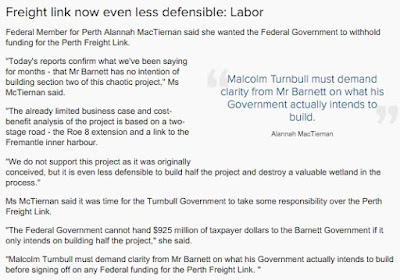
Wonderfully-Horrifying (and Depressing) Trifecta

What a wonderfully-horrifying (and depressing) trifecta of reports juxtaposed in today's West Australian, clearly demonstrating the lack of consistent principle and planning in today's politics at both state and federal levels.

First, there is the report that all transport planning that has been in progress for the past six years under this government is to be dumped ('Key transport plans axed') - almost certainly because the planners have not been coming up with the answers the Premier wants. The replacement plans, of course, won't be finished before the next election, when everything will change yet again.

One of Australia's most respected transport professionals, over 30 years ago, described this state of affairs as 'Planning as a substitute for action'. Some things never change.

Then we have the medical profession calling for more cycleways ('Build more cycleways to stay healthy'), to encourage people to get on bikes and improve their health through exercise. Ironically, this is one area where the WA Government has produced a plan - but unfortunately its funding of it is so woefully inadequate that it will take decades to implement.

And then there is the Federal ALP which, rightly in our view, has agreed to support the Government's fuel excise indexation rather than see the revenue raised so far go back to the oil companies ('Fuel price up twice a year') - but, wrongly in our view, has effectively agreed to all of it being spent on roads rather than on a multi-modal approach to addressing congestion in our cities. 


Written and Posted by Ian Ker, Convenor, STCWA

Federal ALP Agrees With Abbott: Roads, Roads and More Roads

The Federal ALP has changed its position to support fuel excise indexation but only on the condition that $1.1 billion of the $3 billion over four years is spent on rural roads.  http://www.abc.net.au/news/2015-06-23/labor-bows-to-fuel-excise-increase/6566240

The ALP says nothing about the remaining $1.9 billion, which presumably, given Tony Abbott's stated view that the Federal Government should 'stick to its knitting'( which he sees as roads, roads and more roads), will be spent on urban roads. 

Rural roads, where there are no alternatives to road transport, might well be a sensible use of funds, but in urban areas there should at least be the option of spending on alternatives to roads. Even in rural areas, funds could usefully be dedicated to retaining or upgrading rail access (eg for grain in WA).

The STCWA has previously supported fuel excise indexation, but on the condition that the additional revenues be hypothecated to 'walking, cycling and public transport as well as for roads in general' (http://sustainabletransportcoalitionofwa.blogspot.com.au/2014/07/stc-support-for-fuel-excise-indexation.html). We continue to hold that view.

No one, especially Tony Abbott who can ill-afford another billion-dollar budget hole, wants the money from the 2014 fuel excise increase to go back to the oil companies, but Labor has missed a huge opportunity to help safeguard a sustainable future and to differentiate itself from the Government here.

At the same time, Federal MP for Perth, Alannah MacTiernan is sending out a flier rightly criticising the Barnett Government for reneging on its promise to build the MAX light rail and committing to build a non-promise in the Perth Freight Link.

There seems to be an obvious disconnect here.


Written and Posted by Ian Ker, Convenor, STCWA

Thursday, 14 May 2015

Where's the Strategy on Freight and Port Sale?

https://au.news.yahoo.com/thewest/business/a/27918528/budget-delivers-record-deficit
The sale or long-term lease of Fremantle Port, announced in today's WA State Budget, casts a disturbing new light on what was already unseemly haste to get the Perth Freight Link underway. 

It was reported in February that detailed planning for much of the project, including the most difficult section from Stock Road to Fremantle Port, had not yet been done. Yet the Government is already calling for tenders on what, in the absence of such planning, must be a high-risk project for tenderers.

Now we can see why there is such haste - in addition, of course, to the Government's wanting to preclude the possibility of a new incoming government in March 2017 being able to cancel contracts as the Victorian Labor Government did for the East-West Link in Melbourne. The East-West Link was also a major road project with dubious justification and contracts entered into hastily just before an election.

If the Port is to be sold or leased, Perth Freight Link is effectively either an attempt to boost the price or a direct subsidy to the new port owners. 

In the absence of a business case for the Perth Freight Link, we don’t know for sure that boosting the price will cost more than it achieves – an indirect subsidy to the new owners – but it is highly likely. Tenderers for the Perth Freight Link project will, in any case, add a premium for the high risk of the project.

Similarly, tenderers for the Port will discount the price they are willing to pay for the risks associated with the Perth Freight Link - and it is entirely possible that a potential purchaser might prefer to place more emphasis on rail transport of containers from the Port, effectively diluting any value the Perth Freight Link would have.

Whatever the merits of selling or leasing the Port of Fremantle, the conjunction with the haste to get the Perth Freight Link project underway strongly suggests a lack of coherent strategy for freight not only at the Port but more generally. The continual delays in releasing the 'Moving Freight' strategy appear to be a result of the Government's lack of consistency and the resulting 'need' to avoid the embarrassment of a plan that its own actions undermine - as happened with the Public Transport Plan and Government's subsequent abandonment of MAX light rail (Stage 1 priority in the plan) in favour of an Airport rail link (stage 2 priority).

Written and Posted by Ian Ker, Convenor, STCWA

Sunday, 10 May 2015

The Human Scale: Jan Gehl-Inspired Documentary

For those who might have missed the Jan Gehl inspired film, The Human Scale, first time around (http://sustainabletransportcoalitionofwa.blogspot.com.au/2014/07/for-those-interested-in-cities-for.html), it is back on iView (http://iview.abc.net.au/programs/human-scale/ZX9994A001S00) until 24th May.

Deckchairs. Titanic. Where's the Strategic Direction for Transport?

Hot on the heels of the breathless announcement of $40 million to 'improve' congestion hotspots, we have the announcement of $35 million to be spent on four major cycle infrastructure projects.

Sounds good - and the STC certainly supports sensible initiatives to reduce congestion and to fund improved cycle infrastructure. As so often is the case, however, the devil is in the detail.
West Australian 8th May 2015
West Australian 9th May 2015


The problem with a 'hotspot' approach to road traffic congestion is that it runs the risk of both inducing more traffic and shifting the congestion to another place along the road. A classic example of this is the proposal to add capacity to the turning movements between East Parade and the Graham Farmer Freeway, which will put even more pressure on the intersection of Guildford Road, East Parade and Whatley Crescent. And by inducing more traffic down East Parade, it will make it even more difficult for the people who live in the riverside area of Banks Precinct to get to the East Perth train station, which is their main public transport access point.

What is needed is a coherent overall approach to congestion, including demand management and enhancements to non-car travel options, instead of a knee-jerk roll-out of short-term responses.

So what, then, is wrong with the announcement of $35 million for four major cycle infrastructure projects? In part, it is precisely the same point - none of these four projects is among the priority projects identified in the Government's own WA Bicycle Network Plan. Even though the government has a coherent plan for bicycle infrastructure, it has ignored it when it comes to funding.

In fact, at least three of those projects (Mitchell Freeway extension; Reid Highway; Gateway WA) would, in the past, have been funded by Main Roads as an integral part of the road project, under its commitment to ensure that cyclists are provided for safely as part of its road projects. The funding would have been part of the 'business as usual' road budget not trumpeted as something additional.

Ignoring the Network Plan is not the way to get more people on bikes. Just a few days previously, the UK Guardian (http://www.theguardian.com/cities/2015/may/05/amsterdam-bicycle-capital-world-transport-cycling-kindermoord) published a piece on how Amsterdam became the cycling capital of the world (Danes in Copenhagen might want to dispute that) - the key to this was genuine cycle networks. Initially, "bicycle paths were bright red and very visible … cyclists would change their route to use the paths. It certainly helped to keep people on their bikes, but in the end it turned out that one single bicycle route did not lead to an overall increase in cycling. [Then] the City of Delft constructed a whole network of cycle paths and it turned out that this did encourage more people to get on their bikes. One by one, other cities followed suit."

The best 'bang for the buck' for cycling in Perth will come from filling in the gaps in the existing incomplete network, so that we get full value from the investments already made - not from crowing about facilities that would be provided as a matter of course in road construction projects.

http://www.theguardian.com/cities/2015/may/05/amsterdam-bicycle-capital-world-transport-cycling-kindermoord
Written and Posted by Ian Ker, Convenor, STCWA