Comments Welcome

To add a comment to any post on this blog, select the post by clicking on the title either in the post itself or in the list of posts on the left of the page. Then scroll down to the foot of the post and type your comment in the box.
Showing posts with label alternative. Show all posts

Tuesday, 23 February 2016

Problems With Perth Freight Link: Practical and Philosophical

Last Wednesday, 17th February, I spoke as an invited speaker on behalf of the STCWA at a public meeting organised by the Hilton Action Community to discuss issues with the Perth Freight Link. Whilst this meeting was most directly prompted by Transport Minister, Dean Nalder's promoting a tunnel option for a large part of the PFL, it was concerned about all elements - from roe 8, with its major environmental issues, to the lack of connection to the Port itself.

My speaking notes follow, below.

Planning and Governance

Reservations for major roads in Perth are defined in the Metropolitan Region Scheme (MRS), usually for many years, prior to the road being built.
While some parts of the current PFL are shown in the MRS, others are not. To get them into the MRS requires a statutory process by the WA Planning Commission, including public submissions, and formal adoption.
It may not be legal to build those parts of the PFL that are outside an MRS highway reservation. This would appear to include parts of High St, and land for new grade separations at Stock/Leach, Carrington/Leach, High/Stirling and Stirling/Marmion and large parts of any tunnel option.
We should be looking very closely at the Main Roads Amendment Bill currently before Parliament. This grants powers to the Commissioner of Main Roads to undertake works outside road reservations, including clearing vegetation without the need to comply with the Environmental Protection Act.
Infrastructure Australia says the Business Case lies (or at best misleads) about alignment with State Strategic Priorities:
"The Business Case outlines strong links between the Perth Freight Link Project and State priorities, policies and initiatives … but the Perth Freight Link project is not directly mentioned in any of the State plans and policies it mentions.
This appears to be yet another reason why the 'Moving People' and 'Moving Freight' strategies are being rewritten - to comply with the Government’s political narrative.

Contractual

The current PFL proposal appears to be to call tenders for its construction soon: before details have been decided and before the statutory planning process has been completed.
This will create significant risk and uncertainty for potential tenderers to build the PFL, especially when combined with uncertainty about with the proposed sale of the Fremantle Port and the possibility of a change of government.
Letting a contract for the PFL under these circumstances will mean it will cost tax-payers more than if the details have been decided through proper process.
Tenderers will either load their prices up-front to allow for the uncertainties or prepare their tenders in such a way as to maximise extra payments during the course of the contract.
Either way it is certain to be expensive.
It also increases the probability of litigation between the State and the successful tenderer if the uncertainties continue to grow. This will tend to result in delays and further costs that will only be productive to the legal profession.
Exactly the same applies to the sale or leasing of Fremantle Port, which the Minister for Transport has said he wants to have signed off by July/August.
Tenderers will reduce the price they are willing to offer if PFL is uncertain.
If the Port is sold with an expectation about the PFL that is not finally met, the State will be exposed to litigation.
It would save significant taxpayers money and possible litigation to first finalise planning for port development and freight access and then, if you must, offer the Port for sale.


Appraisal

Public investment is usually assessed using benefit-cost analysis. A project is only justifiable if:
a)   the benefits over time exceed the costs; and
b)   the amount by which they do so is greater than for any alternative way of addressing the problem.
The second, in particular, has not been demonstrated for the Perth Freight Link.

Infrastructure Australia itself has not been able to get sufficient information to satisfy itself that the PFL is the best option for dealing with the land transport needs of WA's international container trade.

Indeed, IA 'damns with faint praise' when it concludes:
 "After accounting for these [risk and uncertainty] factors, Infrastructure Australia still has a high degree of confidence that the BCR is greater than 1.0:1 for the project".

According to IA, "Major risks for the project include costs, environmental approvals and community support", which doesn't leave much in the way of certainty, especially as the final link to the port has not yet been defined or costed.

IA could not state that the project is warranted because it didn’t have comparable information on alternatives and therefore could not assess whether other options would provide better value to the WA community.

The evaluated PFL project was selected from 12 possible ones on the basis of subjective criteria, with only the 'preferred' project being subject to full benefit-cost analysis.

None of the 12 options included adequate consideration of the Outer Harbour.


Ethics

Engineers Australia’s Code of Ethics requires professional engineers to promote sustainability. This includes engage responsibly with the community and other stakeholders:
- being sensitive to public concerns
- informing employers and clients of the likely consequences of proposed activities on the community and the environment
- promoting the involvement of all stakeholders and the community in decisions and processes that may impact upon them and the environment.
It also includes:
- balancing the needs of the present with the needs of future generations
- considering all options in terms of their economic, environmental and social consequences
It is clear that the present PFL process is not promoting the involvement of all stakeholders and the community in decisions and processes that may impact upon them and the environment.
It is clear that not all options have been considered in terms of their economic, environmental and social consequences; especially the development and use of the outer harbour and the option of moving freight at night.

It is unfair of the Government to put professional engineers involved in the PFL in a position where they are being asked to act unethically.

Written and Posted by Ian Ker, Convenor, STCWA

Wednesday, 11 November 2015

Multi-Storey Car Mausoleums Are Our 'Horse Graveyards'

Good piece in today's West Australian by Kate Emery, who does us all a great service by drawing attention to the myopia of planning ('They shoot horses, don't they', West Australian, 11th November 2015), using the example of the 'horse graveyards' planned as an 'inevitable' result of dependence on horse-drawn transport in the 19th century.

Our horse graveyards are already with us, in the form of multi-storey car parks. These single-purpose mausoleums are home to inanimate car bodies for most of the day and empty by night.

There is nothing new in planners wanting to reduce our dependence on the private car by creating more accessible places. Twenty years ago, the Perth Metropolitan Transport Strategy stated on its front cover:
"Perth will be a place of vitality and well-being. There will be a sharing of spaces for living, work and leisure activities, which can be reached easily and safely by all members of the community".

If we were actually to achieve this, many of these car mausoleums would be redundant. Indeed, we can already see the beginnings of this in reduced charges (because of lower demand) for car parking in the central city.

Now we need to take the next step and start to reduce the amount of car parking, including requirements in local government town planning schemes - which also increases the density and activity we can get in an area. To do so requires governments to get serious about creating more accessible places, not simply set arbitrary infill development targets, and to make alternatives to the car (public transport, walking and cycling) feasible options for as many of us, in as many places and for as much of the day as possible.
West Australian, 11th November, 2015
Written and Posted by Ian Ker, Convenor, STCWA

Thursday, 20 August 2015

Gareth Parker Agrees - But You Read It Here First

Yesterday, we posted a piece an item about the Infrastructure Australia Summary report on the Perth Freight Link (http://sustainabletransportcoalitionofwa.blogspot.com.au/2015/08/transparency-and-perth-freight-link.html).

Today, Gareth Parker, in the West Australian, presents a very similar take on the IA assessment. His concluding words should be required reading for all involved in this project:
"The Infrastructure Australia assessment gives him [Transport Minister Dean Nalder] cover [on his claims that PFL is a 'fantastic project']. But what he cannot claim is that the PFL is the best solution. That's what taxpayers are entitled to demand"
West Australian, 20th August 2015
Posted by Ian Ker, Convenor, STCWA

Wednesday, 19 August 2015

Transparency and the Perth Freight Link


We have previously commented on this blog about the need for greater transparency and objectivity in government decision-making. The recently (and reluctantly) released Infrastructure Australia report on the Perth Freight Link is a case in point.

This report does provide some greater clarity, but Infrastructure Australia itself has not been able to get sufficient information to satisfy itself that the PFL is the best option for dealing with the land transport needs of WA's international container trade.

Indeed, IA 'damns with faint praise' when it concludes: "After accounting for these [risk and uncertainty] factors, Infrastructure Australia still has a high degree of confidence that the BCR is greater than 1.0:1 for the project".

According to IA, "Major risks for the project include costs, environmental approvals and community support", which doesn't leave much in the way of certainty.

IA does not state that the project is warranted because it did not have comparable information on alternatives and therefore could not assess whether other options would provide better value to the WA community.

"A rapid BCR was completed for the preferred option only, assessed against the Base Case. A rapid BCR was not completed for additional options to determine if the preferred option provided the greatest net benefits."

Infrastructure Australia says the Business Case lies (or at best misleads) about alignment with State Strategic Priorities:

"The Business Case outlines strong links between the Perth Freight Link Project and State priorities, policies and initiatives listed below. At the time of assessment (May 2015), the Perth Freight Link project is not directly mentioned in any of these State plans and policies:
• State Planning Strategy 2050 and Metropolitan Region Scheme;
• Directions 2031 and Beyond;
• Murdoch Specialised Activity Centre Structure;
• Draft Moving People Network Plan;
• WA Regional Freight Transport Network Plan;
• Draft Perth Freight Transport Network Plan;
• Draft State Port Strategic Plan; and
• Fremantle Port Inner Harbour Port Development Plan."

This appears to be yet another reason why 'Moving People' and 'Moving Freight' have abandoned by the Government and are now being rewritten to comply with the political narrative (http://sustainabletransportcoalitionofwa.blogspot.com.au/2015/06/wonderfully-horrifying-and-depressing.html).

IA also states that proposed project was selected from 12 possible ones on the basis of subjective criteria, with only the 'preferred' project being subject to full benefit-cost analysis. None of the 12 options included consideration of the Outer Harbour.

"The preferred option was selected from 12 shortlisted options. All 12 shortlisted options were assessed against selection criteria and assigned an achievability rating. Based on this qualitative assessment, the preferred option was selected from a list of 4 high rated options."

The options considered included pricing and efficiency using existing road infrastructure, investment or subsidisation of rail and a number of road investment options. The options did not include consideration of the Outer Harbour at Cockburn Sound South of Perth."

Transport Minister, Dean Nalder, says that Roe 8 is required even for Outer Harbour (see ABC report, below), but this does not consider other alternatives, including properly configured rail and peripheral road infrastructure.


The Infrastructure Australia Assessment Summary can be found at http://infrastructureaustralia.gov.au/projects/files/WA-Perth-Freight-Link.pdf.

Written and Posted by Ian Ker, Convenor, STCWA

Friday, 22 November 2013

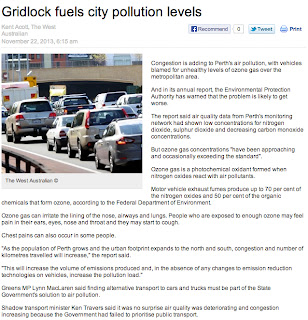
Congestion Costs All Of Us

Click to enlarge
The Environmental Protection Authority has rightly drawn attention to the contribution of motor vehicles to the high levels of ozone often found in the air that we breathe in Perth. 

Ozone is literally an irritant, which poses health risks, but it is by no means the only problem that arises from our over-reliance on the private car. Even setting aside issues of climate change, high traffic volumes cause congestion and community severance.

Congestion is a self-interest issue for car drivers. Every time we drive our cars, it costs us up to 20 cents a kilometre in fuel and maintenance costs. We impose another 20 cents on other road users for each kilometre we drive, through slower travel times and higher fuel and maintenance costs in stop-start traffic.

In peak periods, we impose 30 cents of cost on others for each kilometre we drive.

And have pity on those communities that are severed by the major roads we drive along and the heavy traffic we are part of. Whether this severance is planned (as with freeways and controlled-access highways) or unplanned (as with inner-urban centres that straddle arterial roads such as Beaufort Street, Mt Lawley, and Fitzgerald Street, North Perth), traffic-related severance makes places less attractive (for both people and businesses) and more difficult for people to get from one part another - ironically increasing the likelihood that they will need to use a car to get around locally. 

Funding and traffic priority for public transport is part of the solution, but we also need to focus on improving local accessibility on foot and by bicycle. This includes improving access - not simply providing more car parking - to train stations. At many train stations, 40% of cars parked all day are registered within 3 kilometres of the station, but walk or cycle distances are often greater because of the lack of direct walk/cycle facilities.

The bottom line, though, is that most of us make journeys by car that we could easily make by other means. One in ten car trips is less than one kilometre and one in three is less than three kilometres. 

The solution to congestion lies as much with us as individuals, making appropriate choices about our travel, as it does with us as community, making suitable investments in transport so that we have real alternatives to choose from.