Comments Welcome

To add a comment to any post on this blog, select the post by clicking on the title either in the post itself or in the list of posts on the left of the page. Then scroll down to the foot of the post and type your comment in the box.
Showing posts with label congestion. Show all posts

Tuesday, 23 February 2016

Is Dean Nalder A Mole?

Is Dean Nalder a mole in the WA Government?

He is obsessed with burrowing underground and, in the process, undermines his own government, as a spy might do, by floating whacky ideas.

It is true that destroying existing urban development to widen roads like Stirling Highway is of questionable value, but transport professionals know that building more roads, however you do it, is no solution to congestion - quite the opposite, as more roads simply generate more traffic. 

And if you did build, say, another Stirling Highway under the existing one, where and how would drivers get on and off - or must they all go all the way from Perth to Fremantle? Access/egress points would take large amounts of land - most likely at places where land is at a premium, because those are the places people want to get to.

Cheap though tunnelling might be in Perth sand, the cost would still be substantial. It is disingenuous of the Minister to claim that it would not be at the expense of public transport and cycling - unless he has somehow found the money tree that Premier Colin Barnett appears to believe exists somewhere, if only he could find it.

It's time, Minister, to commit to cost-effective strategies for walking, cycling and public transport to provide real options for the people of Perth, which would also improve road traffic conditions for those who still have to use cars, commercial and freight vehicles.

The West Australian, 23rd February, 2016

Friday, 22 November 2013

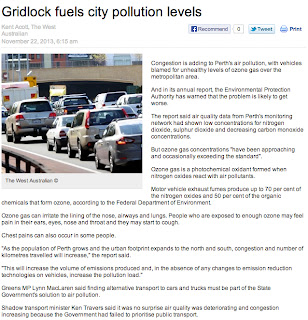
Congestion Costs All Of Us

Click to enlarge
The Environmental Protection Authority has rightly drawn attention to the contribution of motor vehicles to the high levels of ozone often found in the air that we breathe in Perth. 

Ozone is literally an irritant, which poses health risks, but it is by no means the only problem that arises from our over-reliance on the private car. Even setting aside issues of climate change, high traffic volumes cause congestion and community severance.

Congestion is a self-interest issue for car drivers. Every time we drive our cars, it costs us up to 20 cents a kilometre in fuel and maintenance costs. We impose another 20 cents on other road users for each kilometre we drive, through slower travel times and higher fuel and maintenance costs in stop-start traffic.

In peak periods, we impose 30 cents of cost on others for each kilometre we drive.

And have pity on those communities that are severed by the major roads we drive along and the heavy traffic we are part of. Whether this severance is planned (as with freeways and controlled-access highways) or unplanned (as with inner-urban centres that straddle arterial roads such as Beaufort Street, Mt Lawley, and Fitzgerald Street, North Perth), traffic-related severance makes places less attractive (for both people and businesses) and more difficult for people to get from one part another - ironically increasing the likelihood that they will need to use a car to get around locally. 

Funding and traffic priority for public transport is part of the solution, but we also need to focus on improving local accessibility on foot and by bicycle. This includes improving access - not simply providing more car parking - to train stations. At many train stations, 40% of cars parked all day are registered within 3 kilometres of the station, but walk or cycle distances are often greater because of the lack of direct walk/cycle facilities.

The bottom line, though, is that most of us make journeys by car that we could easily make by other means. One in ten car trips is less than one kilometre and one in three is less than three kilometres. 

The solution to congestion lies as much with us as individuals, making appropriate choices about our travel, as it does with us as community, making suitable investments in transport so that we have real alternatives to choose from.